Audio Lecture Series -- The US Patent Application Process
- Fourteen lectures, each one-half hour in length
- Format: MP3
- Download: a Zip archive of 410 megabytes.
- Inside the Zip archive are fifteen MP3 files - one for each
patent lecture and a bonus lecture on trademarks
- Also inside the Zip archive is a fifteen-page study guide
- Recorded live before an audience of law students in the Spring of
2009.
You may listen to a
sample
lecture in this series.
These lectures provide an introduction to and survey of the US patent
application process. Topics discussed include:
- parts of a patent application
- minimum requirements to obtain a filing date
- why we care about our filing date
- ways of filing patent applications
- the significance of "counts" within the USPTO
- docketing steps relating to the filing of a patent application
- requests not to publish a patent application
- small entity status
- oath or declaration of inventorship
- application data sheets
- assignments
- powers of attorney
- customer numbers
- Public PAIR and Private PAIR
- restriction requirements and traversal
- the substantive examination process
- provisional patent applications
- divisional applications and continuations
- claiming the benefit of earlier patent applications, domestic and
foreign
- requests for continued examination
- the appeal process
- petitions to revive
Throughout the lectures, Professor Oppedahl describes Best Practices to
be followed by patent applicants at various points in the application
process.
Who should listen to these lectures? You should listen to these
lectures if:
- you are a lawyer or law student who is just learning about the patent
process
- you are a secretary or administrative assistant or paralegal who is
just learning about the patent process
- if you are starting your training to be a patent docket clerk in a
law firm or corporate legal department
- if you are an in-house general counsel supervising outside patent
firms
The only person who would not benefit from these lectures
is a person who is already very familiar with the entire US patent application
process.
About the lecturer
Your lecturer is Professor
Carl
Oppedahl.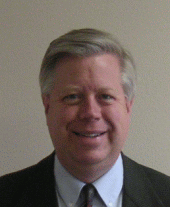 Professor Oppedahl is the
founder of the Oppedahl
trademark Law Firm, and has been practicing intellectual property law for
over two decades. His firm has obtained
many hundreds of
US patents for clients of the firm. He received a bachelor's degree in
physics and mathematics from Grinnell College, and received his JD from Harvard
Law School. Professor Oppedahl has served as the chair of the Patent
Cooperation Treaty Issues committee of the American Intellectual Property Law
Association and as the chair of the Electronic Business committee of that
association. He is admitted to practice before the USPTO and before many courts
including the Court of Appeals for the Federal Circuit and the US Supreme
Court. Professor Oppedahl teaches Advanced Patent Law as an adjunct professor
at the University of Denver School of Law.
Professor Oppedahl is the
founder of the Oppedahl
trademark Law Firm, and has been practicing intellectual property law for
over two decades. His firm has obtained
many hundreds of
US patents for clients of the firm. He received a bachelor's degree in
physics and mathematics from Grinnell College, and received his JD from Harvard
Law School. Professor Oppedahl has served as the chair of the Patent
Cooperation Treaty Issues committee of the American Intellectual Property Law
Association and as the chair of the Electronic Business committee of that
association. He is admitted to practice before the USPTO and before many courts
including the Court of Appeals for the Federal Circuit and the US Supreme
Court. Professor Oppedahl teaches Advanced Patent Law as an adjunct professor
at the University of Denver School of Law.
Frequently asked questions:
- Does this lecture series prepare me for the USPTO patent bar
exam ("agent's exam")? No, this lecture series will not come even
remotely close to preparing you for the patent bar exam. Passing the patent bar
exam requires far more than passively listening to a mere fourteen hours of
lectures. It requires working old exams, preparing and reviewing flash cards,
and detailed study of the minutiae of the patent law and rules. For someone who
is just starting the process of studying for the patent bar exam, this lecture
series will, however, provide a very helpful survey of some of the topics that
you will need to study and master.
- I'm an attorney and I took a patent law course in law school.
Why should I listen to these lectures? Law school patent courses vary
from one law school to the next, but many law school patent courses focus more
on legal principles and theories of patent law than on the nuts and bolts of
the day-to-day patent application process. If you have not been exposed in
detail to the nuts and bolts of day-to-day patent prosecution, then this
lecture series is for you.
- I'm an attorney. I assume that when I start my job at my law
firm or corporation, there will be non-attorney staff will attend to all
day-to-day tasks and I will never need to know about these things. Isn't this
lecture series really for non-attorneys? Think about it. As an
attorney, you have ultimately responsible for all of the work done by
non-attorneys under your supervision. To competently supervise the work of your
staff, you should know everything about the day-to-day things that your staff
are supposed to know. If you have not been exposed in detail to the nuts and
bolts of day-to-day patent prosecution, then this lecture series is for you.
- What are the license terms for the download of this lecture
series? You are permitted to use the downloaded files the same way you
would use a physical book. Just as you can read a book, and then pass it along
to a single other person, so you may pass along these downloaded files to
someone else. But you may not pass along these downloaded files to to other
people, any more than you could give a single book to two people. If you pass
along these downloaded files to someone else, you may not retain a copy, any
more than you could give a book to someone and still keep a copy of the book.
You must not post these downloaded files on a server where multiple people can
make copies of the files.
- What if something goes wrong with my downloading process?
Our e-commerce server keeps track of what you have purchased. You can
log in at the server again and you can see what you have ordered. You can then
click on the link and download the software again.